Safety Squat Bar Guide: Benefits, How to Use One, and Buying in Australia
The short answer: a safety squat bar (SSB) is a cambered barbell with a padded yoke and forward handles that lets you squat heavy without pulling your shoulders into an uncomfortable rack position. If back squats hurt your shoulders, elbows or wrists — or you want more quad and upper-back work from your squat — it’s the single best specialty bar you can add. In Australia a quality Olympic SSB costs around ~$250 (e.g. the 7ft Olympic Safety Squat Barbell, ~$250).
What is a safety squat bar?
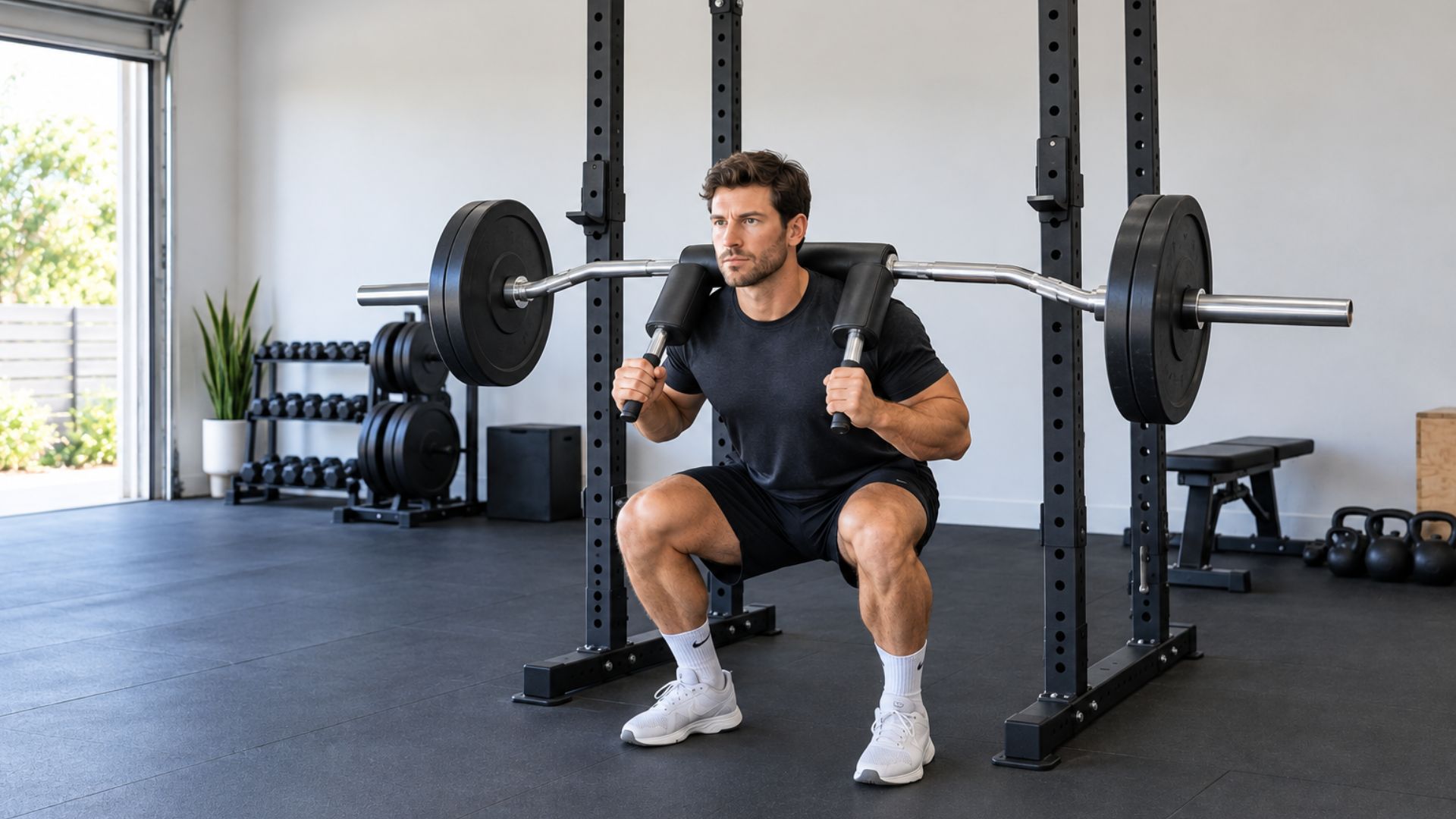
An SSB has three things a straight bar doesn’t: a padded yoke that sits the load on your traps and shoulders, handles that extend forward so you grip in front of your chest instead of behind your head, and a cambered shape that shifts the weight slightly forward and lower than a straight bar. The result is a squat that feels like a cross between a high-bar back squat and a front squat — upright torso, heavy quad and upper-back demand, and zero strain on shoulder mobility.
Why lifters use one
- Squat around injuries. No externally-rotated grip means shoulder, elbow, wrist and pec issues stop being a reason to skip squats. This is the #1 reason SSBs exist.
- More quads and upper back. The forward camber tries to fold you over; fighting it hammers the upper back and keeps the torso upright, which biases the quads.
- Safer solo training. Hands are free to grab the rack’s safeties or uprights at any point, and dumping the bar is more controlled.
- Easier to learn. Beginners find the SSB pattern more natural than balancing a straight bar on their back.
- Variety that carries over. SSB squats, good mornings and split squats build the exact positions that improve your straight-bar lifts.
Safety squat bar vs regular back squat
| Safety squat bar | Straight bar back squat | |
|---|---|---|
| Shoulder mobility needed | None — hands hold front handles | Significant — behind-the-neck grip |
| Torso position | More upright | More forward lean (esp. low bar) |
| Muscle emphasis | Quads, upper back | Glutes, hips, whole posterior chain |
| Load you can lift | Usually a bit less | Highest of any squat variation |
| Learning curve | Low | Moderate |
| Competition lift | No | Yes (powerlifting) |
Prices are indicative and rounded – check the linked product pages for current pricing.
They’re teammates, not rivals — many strength coaches rotate SSB blocks into back-squat programs specifically to build quads and upper back while shoulders get a break.
How to use a safety squat bar
- Set it in the rack at the same height as your normal squat — the pad sits where a high-bar squat would.
- Duck under, centre the yoke on your traps and grip the handles — pull them down slightly to lock the bar in place.
- Brace and squat. Expect the bar to push you forward out of the hole; fight it by staying tall and driving your upper back into the pad.
- Start about 10–20% lighter than your straight-bar squat and build from there.
Worth trying once you’re comfortable: SSB good mornings (brutal, in the best way), box squats, split squats, walking lunges, and Hatfield squats — holding the rack uprights for support, which lets you overload well beyond your normal squat.
Buying a safety squat bar in Australia
What to check before you buy:
- Rack compatibility. A full-length (7ft) SSB spans standard squat rack J-hooks; short versions may not. Ours is 7ft and fits any full-width squat rack.
- Bar weight. SSBs are heavier than straight bars — always check the listed weight and count it in your loading.
- Pad quality. The yoke pad carries the entire load; dense, well-stitched padding is the difference between comfort and a neck-ache.
- Sleeve type. Olympic (50 mm) sleeves so it takes your existing Olympic plates and bumpers.
- Price. Around ~$250 AUD for a quality Olympic SSB — the 7ft Olympic Safety Squat Barbell with clips is ~$250 with Australia-wide delivery.
If shoulder-friendly training is the goal, the SSB pairs naturally with a multi-grip (Swiss) bar (~$250) for neutral-grip pressing and a trap bar (~$300) for deadlifts — between the three, every big lift has a joint-friendly version. For the full rundown on bar types, see our barbell buying guide.
Safety squat bar FAQs
How much does a safety squat bar cost in Australia?
Around ~$250 AUD for a quality 7ft Olympic safety squat bar. Premium imported versions can run ~$500+, but for home and studio use the ~$250 tier does everything most lifters need.
Is the safety squat bar harder than a regular squat?
Rep for rep, most lifters find it harder — the forward camber constantly tries to tip you over, so your quads and upper back work overtime. Expect to lift roughly 10–20% less than your straight-bar squat at first.
Can a safety squat bar replace back squats?
For general strength and muscle, yes — you can build an entire lower-body program around it. If you compete in powerlifting you still need straight-bar practice, but SSB blocks are a standard off-season tool even for competitors.
Is a safety squat bar worth it for a home gym?
If you have any shoulder, elbow or wrist issues, it’s arguably the most valuable ~$250 in strength equipment. If your joints are fine, it’s a luxury that adds quad-focused variety — nice to have, not essential.
What rack do I need for a safety squat bar?
Any standard squat rack or power rack works — a 7ft SSB sits in J-hooks exactly like a straight bar. Set your safeties as normal; the SSB is actually easier to bail from since your hands are free.

Dynamo Fitness Equipment