
Pilates Reformer Exercises for Beginners
Getting Started with Pilates Reformer Exercises
Starting reformer Pilates can feel overwhelming — new equipment, unfamiliar terminology, and a lot of springs to figure out. The good news is that the foundational exercises are straightforward, highly effective, and accessible to complete beginners from day one.
If you are new to a pilates reformer machine, this guide covers the essential exercises to learn first, with simple technique cues for each movement.
Before You Begin: Setting Up Your Reformer
Before jumping into exercises, spend a few minutes getting familiar with your machine:
- Carriage position — sit or lie on the padded carriage and feel how it slides along the rails
- Spring resistance — start with one or two medium springs for most beginner exercises. Less is more when learning technique
- Footbar height — adjust to a comfortable height where your knees are slightly bent in the starting position for footwork exercises
- Shoulder rests — position so your shoulders press gently against them when lying down, preventing you from sliding up
Beginner Pilates Reformer Exercises
1. Footwork Series
The footwork series is the foundation of reformer Pilates and the starting point for almost every beginner session. You lie on your back with feet on the footbar and push the carriage away by extending your legs.
How to do it: Lie on your back on the carriage with feet hip-width apart on the footbar. Press the carriage away by straightening your legs fully, then slowly return. Keep your lower back pressed into the carriage throughout. Perform 10 repetitions.
Muscles targeted: Quadriceps, hamstrings, glutes, calves.
Spring setting: 2–3 medium springs for beginners.
2. The Hundred
A classic Pilates core exercise adapted for the reformer. The spring resistance adds challenge to the traditional mat version.
How to do it: Lie on your back and hold the straps with arms straight toward your feet. Lift your head and shoulders off the carriage into a Pilates curl. Pump your arms up and down in small movements while breathing in for 5 counts and out for 5 counts. Complete 100 pumps (10 breath cycles).
Muscles targeted: Core, hip flexors, shoulders.
Spring setting: 1 light spring to begin.
3. Leg Circles
Leg circles improve hip mobility and core stability simultaneously. The moving carriage adds an additional balance challenge.
How to do it: Lie on your back and place your feet in the straps with legs extended toward the ceiling. Draw small circles with both legs simultaneously — 5 circles clockwise, then 5 anticlockwise. Keep your pelvis stable and lower back flat throughout.
Muscles targeted: Hip flexors, inner and outer thighs, core.
Spring setting: 1–2 light springs.
4. Short Spine
Short spine is a spinal articulation exercise that improves flexibility and coordination of the spine.
How to do it: Lie on your back with feet in the straps, legs extended. Draw the carriage in toward your body as you roll your hips and spine off the carriage one vertebra at a time until your hips are stacked above your shoulders. Then slowly lower back down with control.
Muscles targeted: Spine, hamstrings, core.
Spring setting: 1–2 medium springs.
5. Rowing — Front
A seated upper body exercise that builds shoulder strength and posture.
How to do it: Sit facing the footbar holding the straps. Extend arms forward, then pull the straps back to your sides while keeping your back straight and shoulders down. Slowly release back to start.
Muscles targeted: Upper back, shoulders, core.
Spring setting: 1 light-medium spring.
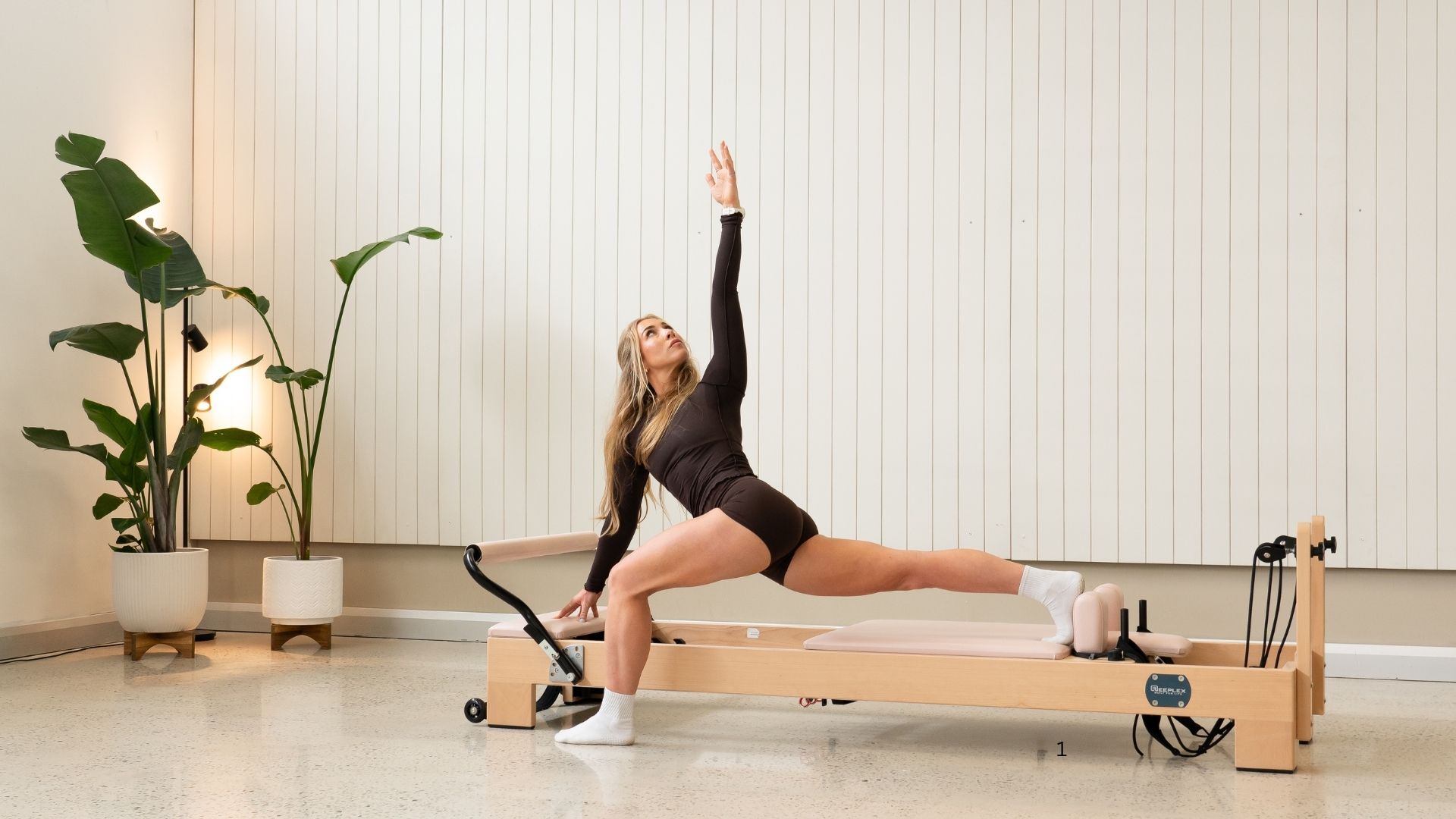
6. Standing Side Split
A beginner-friendly standing exercise that challenges balance and targets the inner thighs and hips.
How to do it: Stand on the carriage and the frame with one foot on each. Slowly push the carriage out with one foot, then draw it back in using your inner thigh. Keep your upper body upright and your core engaged throughout.
Muscles targeted: Inner thighs, glutes, core.
Spring setting: 1–2 medium springs.
Tips for Your First Few Sessions
- Start with lighter resistance — it is easier to learn correct technique with less spring tension. You can always increase resistance once the movement pattern is established
- Move slowly and with control — reformer Pilates is not about speed. Slow, controlled movement activates the deep stabilising muscles you are trying to target
- Focus on breathing — inhale to prepare, exhale on the effort. Connecting breath to movement is a core principle of Pilates and improves results significantly
- Rest if needed — beginner sessions often leave muscles working that have not been engaged before. It is normal to feel fatigue quickly. Rest and continue
- Consider a few guided sessions first — if possible, attend a class or have an instructor guide you through setup and technique before training independently at home
How Often Should Beginners Train?
For beginners, two sessions per week is a good starting point. This allows adequate recovery while building strength and familiarity with the machine quickly. As you progress, you can increase to three or four sessions weekly.
Ready to Start?
Dynamo Fitness stocks a full range of pilates reformer machines suitable for home beginners through to advanced practitioners. Visit a showroom across Perth, Melbourne, Sydney, Brisbane, Adelaide, or the Gold Coast to try the equipment before you buy.

Dynamo Fitness Equipment